FSI installs the Azenco R-BLADE for Puget Sound homeowners who want a motorized louvered pergola that seals against rain and opens on demand. No leaks. No noise. No leaving it to the weather.
Most pergola louvers sit open. They hold water. Zippers jam. Once jammed the screen will not retract and the fabric tears.
R-BLADE was engineered for Pacific Northwest hurricane conditions. The dual-wall louvers seal completely when closed. Rain routes away through integrated gutters inside each post. No ponding. No drips. No going inside when October arrives.

FEATURE 1
Dual-wall louvers seal completely when closed. No gaps. No drip lines. Water routes into the integrated gutter channel and exits at grade through the post system.

FEATURE 2
The louver core that moves water away and resists wind uplift. Tighter seal and superior wind resistance compared to standard single-wall louvered systems.
.avif)
FEATURE 3
Will not keep you or your neighbors up. Less than 47dB in operation. One conversation point of noise. Remote, wall control, app, or smart home integration.
The System
.avif)
Build The Full Space

Enclose the sides of your R-BLADE with the patented dual-pull magnetic screen system. Bugs out. Wind controlled. Solar, vinyl, or insect screen material. Same proposal. Same install.
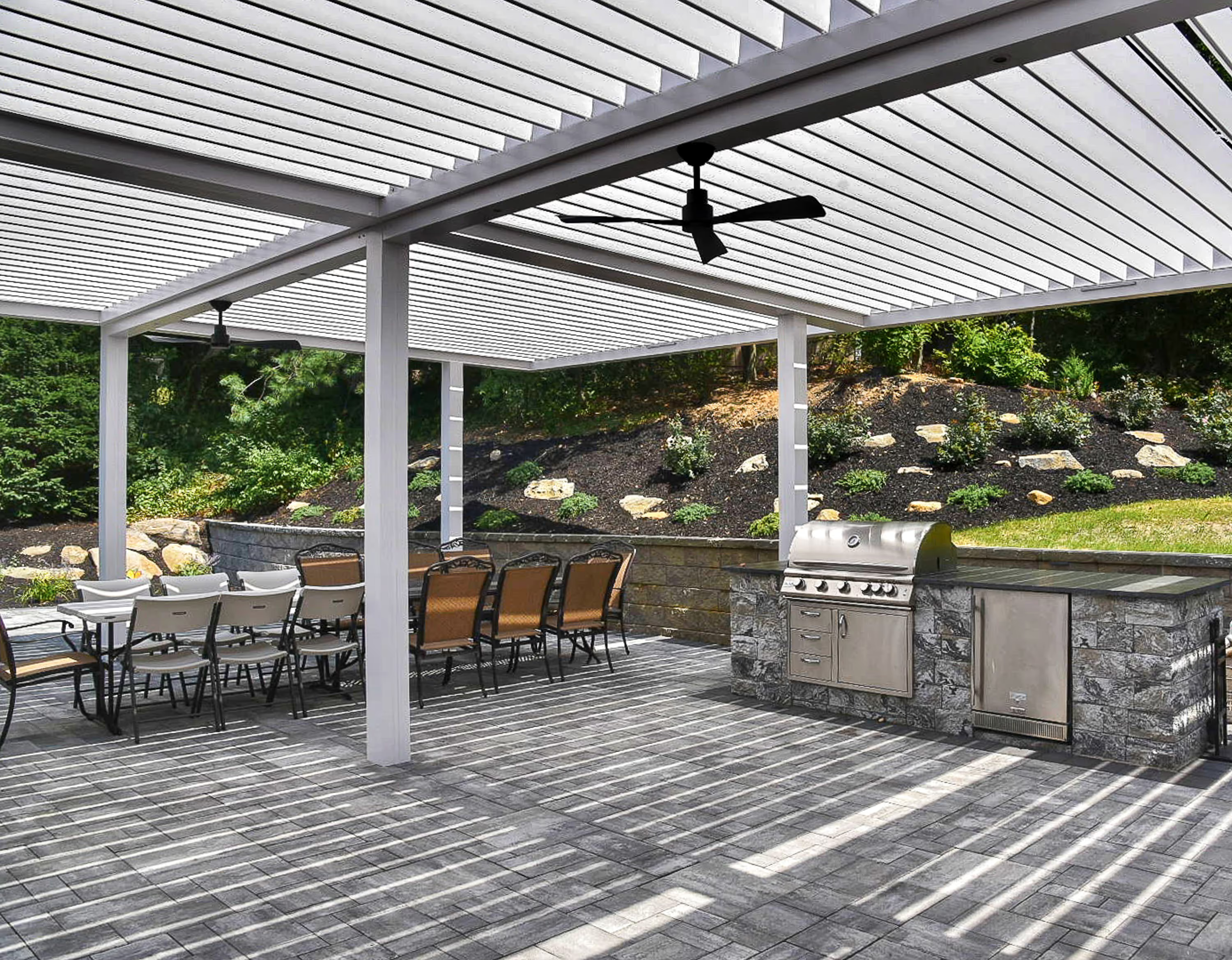
Aluminum-welded frame. Custom cabinetry. Commercial-grade appliances. Stone or tile facing matched to your home. Built to integrate with the pergola structure.
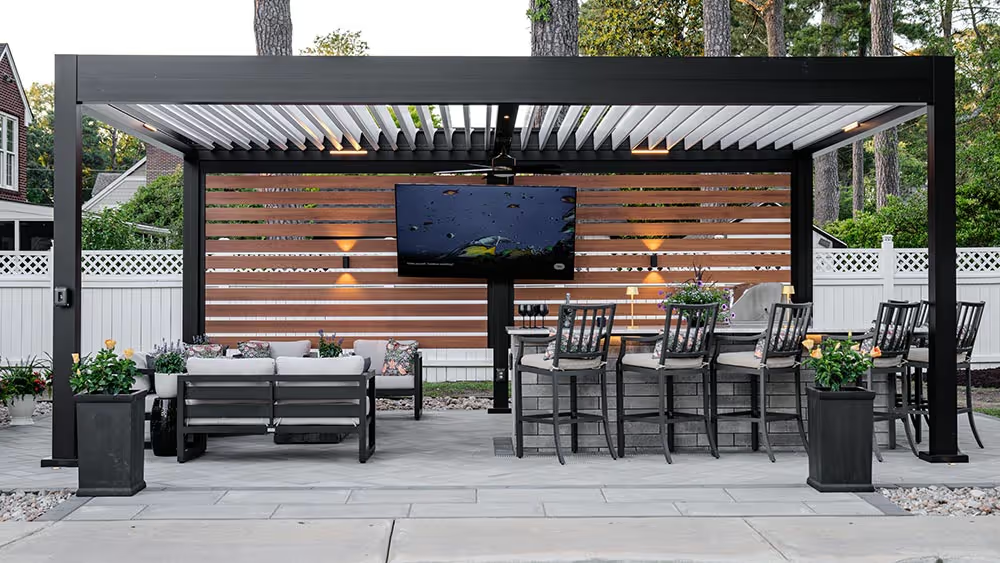
Outdoor-rated TV, patio speakers, and smart controls. Installed by the team that spent 20 years in low-voltage before building their first pergola.
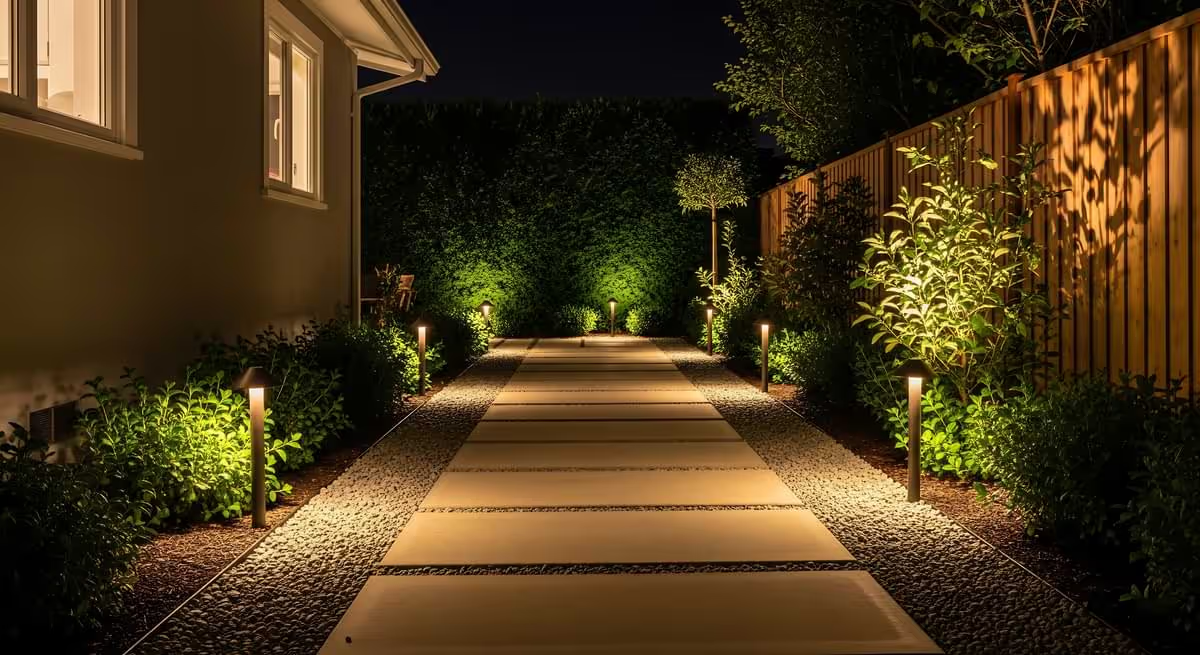
Recessed LED and LED strip lighting inside the R-BLADE structure. Designed during the build. Your outdoor space stays usable after dark.
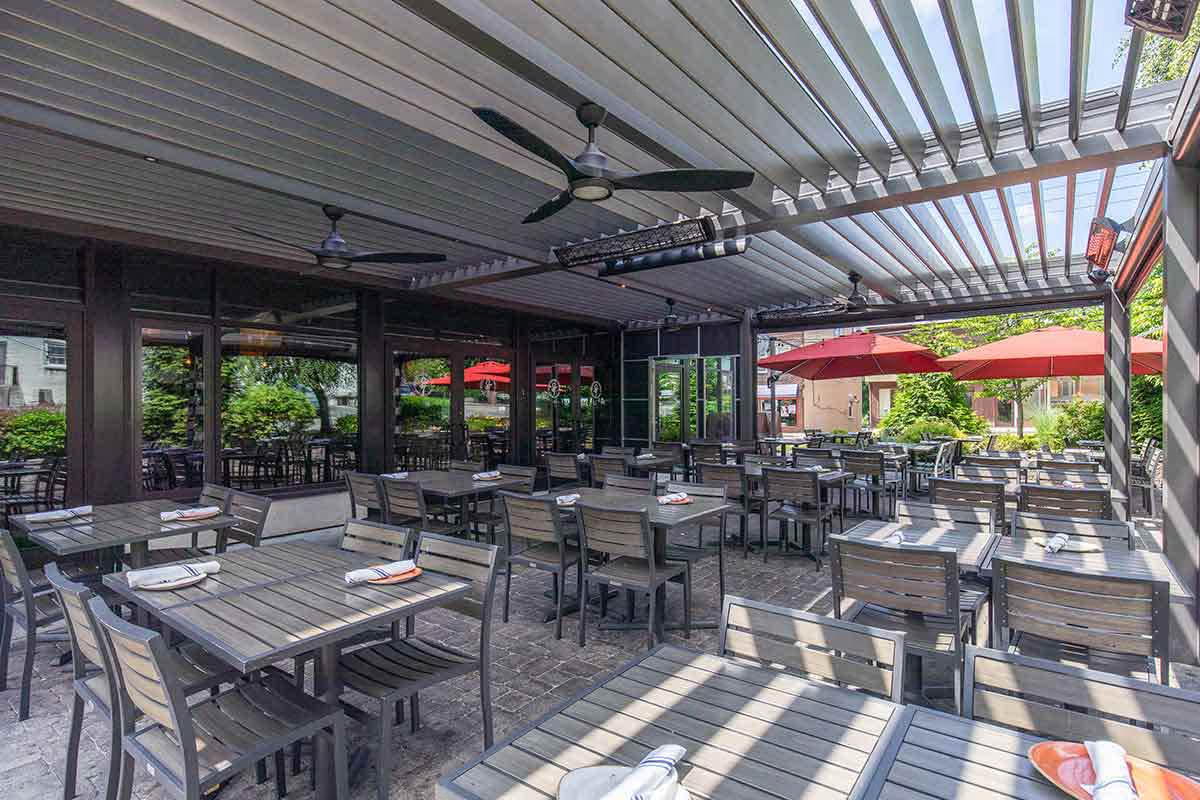
Restaurants, breweries, hotels, and venues across the Puget Sound use the R-BLADE to keep outdoor seating open year-round. Motorized louvers open for sun and close for rain on demand. Staff controls the entire system from one app. FSI installs and services commercial R-BLADE systems with the same precision as residential.
common questions
The key functional difference is deployment style, footprint, and intended weather performance. A retractable awning mounts to a wall and extends horizontally over an area adjacent to the building — a fabric shade system that retracts when not in use. A pergola is a freestanding or wall-attached structure with its own aluminum frame, roof system, and structural posts that define a dedicated outdoor space — it is a permanent architectural element. An awning is typically a lower-cost, faster-installation solution for shading a door, window, or small patio area where a full pergola footprint is not appropriate. A pergola defines and covers a larger outdoor room with more structural permanence, weather performance options, and integration potential for screens, kitchens, and technology. FSI installs both — the consultation determines which is appropriate for the specific application and budget.
The K-BANA is generally priced lower than the R-BLADE because the motor system, weather sensors, control electronics, and motorization components are not present. The exact price difference depends on the K-BANA's size, wall configuration, and any add-ons like lighting or MagnaTrack screens versus the R-BLADE's size and add-on configuration. In general terms, a K-BANA of equivalent footprint to an R-BLADE will be meaningfully less expensive. Whether the price difference is the right tradeoff depends on the use case. For Pacific Northwest homeowners who want year-round weather protection and smart home integration, the R-BLADE's capabilities justify the premium. For homeowners whose primary use case is summer shade in a partially sheltered location, the K-BANA's price advantage may be the better fit. FSI presents both options during the consultation for customers whose use case could reasonably fit either product.
The R-BLADE has motorized louvers controlled by remote, app, or automated sensors — they open and close electrically in response to weather and user input. The K-BANA has manual louvers adjusted by hand at 130 degrees of rotation. The R-BLADE responds to rain automatically and provides gapless waterproof coverage when closed. The K-BANA provides shade management and partial weather protection but does not seal against sustained rain the way the motorized R-BLADE does. The R-BLADE is the premium motorized product suited for year-round Pacific Northwest weather management. The K-BANA is the manual product suited for shade control and aesthetic value in a simpler, lower-cost system. FSI recommends the R-BLADE to most Pacific Northwest customers who want year-round usability. The K-BANA is recommended where the primary use case is summer shade or where the price difference is a meaningful factor.
The key difference is adjustability versus protection. The R-BLADE's motorized louvers open fully to let in sun and close to block rain, adapting to conditions in real time. The R-SHADE's insulated panels are fixed — the roof is always closed, always providing full protection, always insulating. The R-BLADE is the right choice if you value flexibility — using the full open roof on clear summer days and closing it against fall rain. The R-SHADE is the right choice if you value maximum protection — you want the overhead space to function like a covered room regardless of weather, and you are not trading protection for sunlight access. In terms of rain performance in Pacific Northwest conditions, the R-SHADE is the stronger specification. In terms of year-round versatility, the R-BLADE is the stronger specification. FSI walks through both options with every customer whose use case could fit either model.
The R-BLADE has motorized louvers that open and close electrically and can be set to any angle from fully open to fully closed, with automated rain and temperature sensors. The R-BREEZE has fixed louvers set permanently at 55 or 90 degrees with no adjustment capability. The R-BLADE is the right choice if you want year-round weather flexibility, maximum rain protection, and smart home integration. The R-BREEZE is the right choice if you want a clean architectural aesthetic, consistent shade at a fixed angle, and no mechanical system to maintain. For homeowners in the Pacific Northwest who want real weather protection through fall and winter, FSI recommends the R-BLADE over the R-BREEZE — the inability to close against rain is a meaningful limitation in this climate. FSI walks through the specific use case and site conditions with every customer before recommending a model.
The R-BLADE's primary technical advantage over most competing louvered pergola systems is the flat dual-walled louver design and the fully integrated drainage system. Most competing systems use a curved or S-shaped louver profile that pools water in the trough of the curve when the roof is closed — when the louvers open after rain, the pooled water dumps onto the space below. The R-BLADE's flat louver profile sheds water rather than pooling it, and the integrated post drainage system handles all water invisibly. The R-BLADE is also engineered to meet High-Velocity Hurricane Zone requirements — a structural specification standard that competing systems do not typically carry. StruXure is a legitimate competing product with ICC certification, but the Azenco drainage engineering and FSI's installation expertise are the meaningful differentiators in Pacific Northwest conditions where rain management is the primary structural challenge.
R-BLADE add-ons available through FSI include: MagnaTrack motorized screen enclosure systems that convert the covered space into a three-season room, LED recessed lighting and LED strip lighting integrated into the pergola beam soffit, fan beam fixtures that combine airflow with integrated LED, privacy wall panels in glass or aluminum louver configurations, infrared heaters from Infratech and Bromic in ceiling-mount or post-mount configurations, outdoor TV installation with concealed cable runs, and patio and landscape speaker systems. Most FSI customers add at least screens and lighting to the base pergola installation — the combination of overhead coverage, screen enclosure, and LED lighting is what creates an outdoor room that is genuinely usable year-round.
The R-BLADE motor system is compatible with multiple control methods and smart home platforms. Standard included controls are a handheld remote and a wall-mounted switch. App control is available through the Gaposa-compatible motor system, which connects to Wi-Fi and is accessible through the Gaposa app or through integration with a major smart home platform. Supported smart home platforms include Control4, Savant, Lutron, and Crestron. When integrated into an existing smart home system, the pergola louvers appear as a controllable device in the home's existing interface alongside interior shades, lighting, and climate. FSI handles the smart home integration as part of the installation and commissioning process. The integration is not subcontracted to a third party.
The R-BLADE is available in both wall-mount and freestanding configurations. Wall-mount installations attach the structure to an exterior wall of the home using a ledger system — the most common configuration for installations adjacent to the home's back door or sliding door. Freestanding installations use four posts and no wall attachment — appropriate for locations away from the home's exterior wall, for decks where wall attachment is not structurally feasible, or for commercial applications. FSI assesses the site conditions during the initial consultation to determine which configuration is appropriate. Wall attachment requires a structural connection to the home's framing, and FSI confirms the wall assembly and structural backing before specifying a wall-mount configuration.
Water drainage in the R-BLADE is managed by the integrated gutter system built into the structure's posts. When the louvers are closed, the louver surface sheds water inward to a continuous gutter channel that runs along the interior edge of the structure. The gutter channel directs water into the vertical post channels, which function as internal downspouts carrying water to the ground at the base of each post. The entire drainage path is concealed inside the structural aluminum — from the louver surface to the ground, no water is visible, no external hardware is exposed, and no splash occurs at the base because the water exits at grade level through a small drain point rather than dropping from a downspout height. This system was engineered to handle the rainfall rates of High-Velocity Hurricane Zone conditions in Florida, and in the Pacific Northwest it operates with significant capacity margin above the typical rainfall events the region produces.